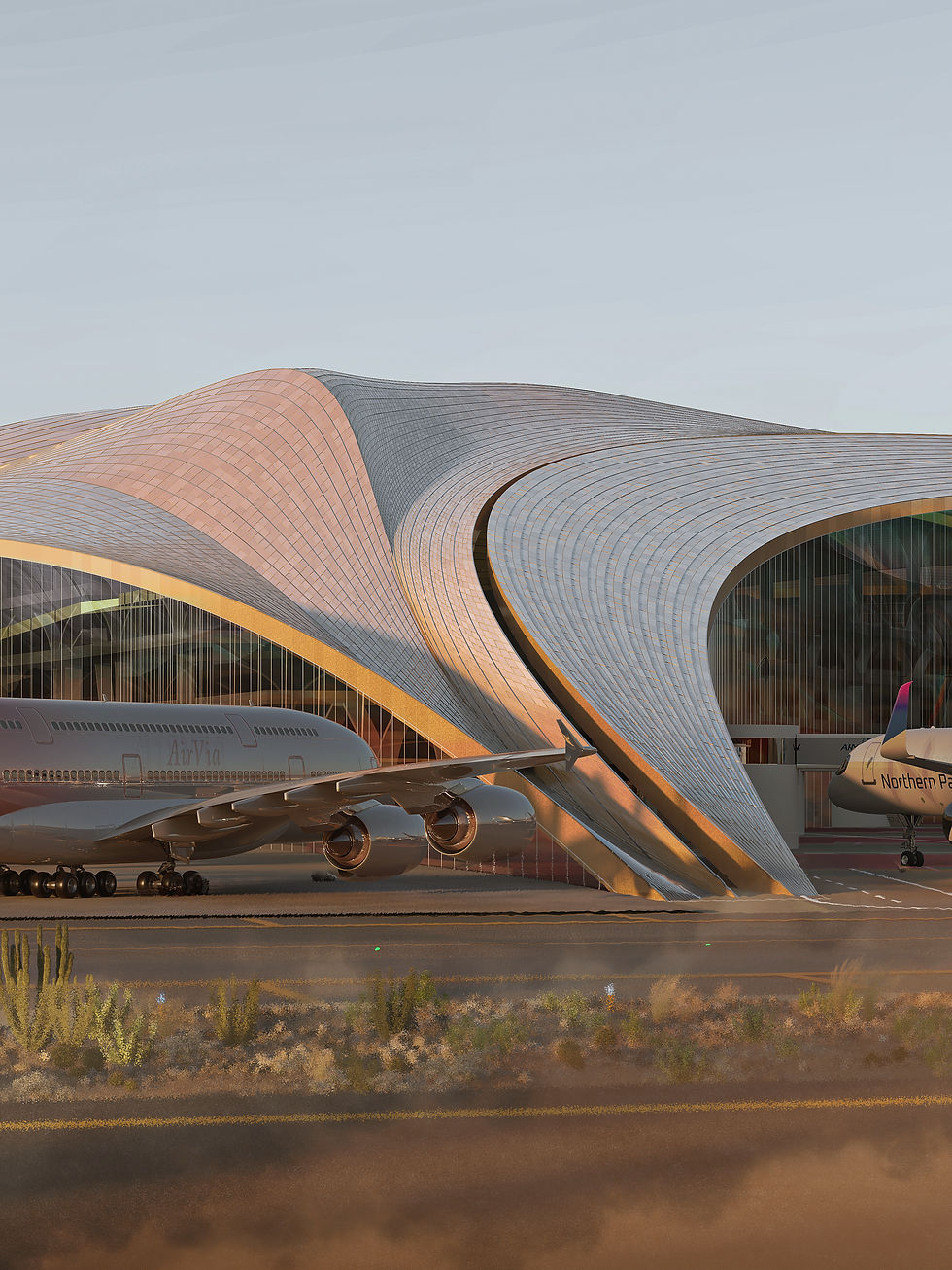
FUTURE TRANSPORT HUBS
FUTURE TRANSPORT HUBS
High-speed rail (HSR), eVTOL systems, and drones are redefining transport infrastructure. Visualization is no longer just presentation, but a tool to verify spatial logic, movement, and integration across multiple transport layers. It allows architects to evaluate complex systems early in the design process.
CONTEXT-DRIVEN ASSET SELECTION
Accurate visualization depends on selecting the right transport elements. We work with HSR trains, eVTOL aircraft, and drones that match the project’s geographic and regulatory context. Every asset is chosen to reflect real-world operation, not generic representation.
MULTI-LAYERED TRANSPORT SYSTEMS
Contemporary hubs operate across stacked transport layers, from underground lines to rooftop vertiports. Visualization must clearly communicate how these systems interact. We focus on readable flows and spatial hierarchy to ensure the design works as an integrated whole.
VISUALIZING LINEAR INFRASTRUCTURE
Rail corridors and high-speed lines are often difficult to read in standard perspectives. Their scale and continuity tend to disappear or fragment. We use specific compositions and viewpoints that preserve direction, hierarchy, and overall system clarity.
URBAN IMPACT AND SCALE
Transport hubs significantly reshape their surroundings. Visualization helps define their relationship to the city and test their impact at multiple scales. This makes it easier to communicate both immediate design intent and long-term development potential.
HIGH-SPEED RAIL


AIRPORTS